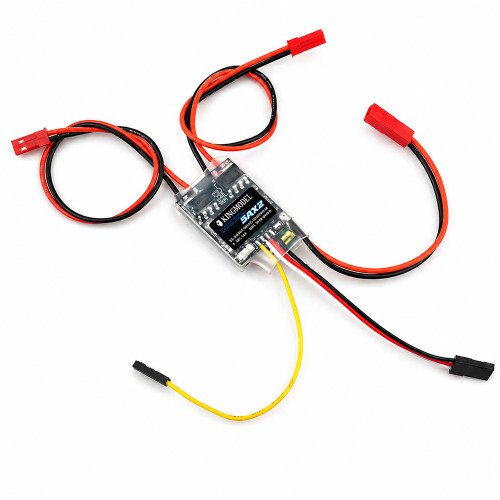
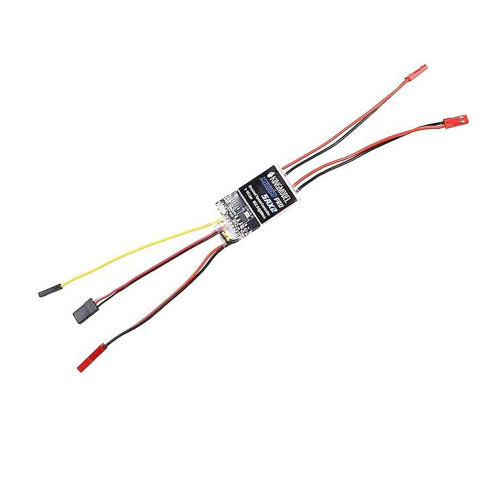
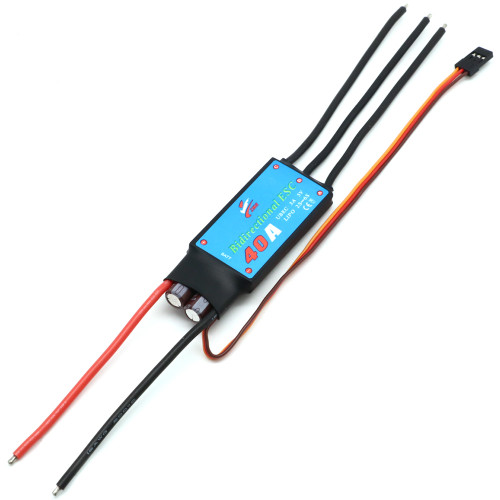
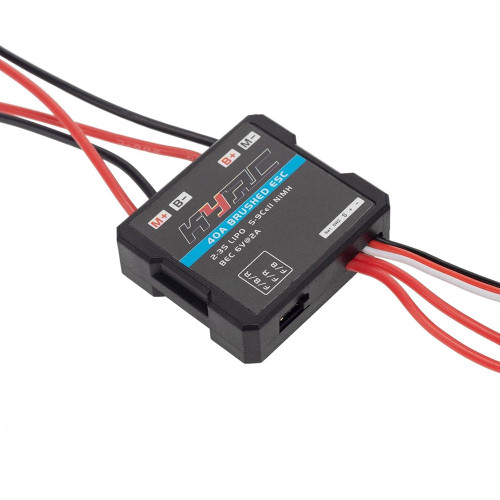
Two-Way Bidirectional Brushed Dual-Channel ESC 20Ax2/30Ax2/40Ax2 for 2-6S LiPo - High-Current Independent Motor Controller with 5V 3A BEC for RC Tank and Speed-Differential Boat
The Two-Way Bidirectional Brushed Dual-Channel Electronic Speed Controller is available in 3 current-rated variants - 20Ax2, 30Ax2, and 40Ax2 - covering a total continuous output range of 40A through 80A across both motor channels. Each variant delivers its rated current independently across 2 channels, driving separate left and right brushed motors simultaneously from a single controller board on a wide 2-6S LiPo input spanning 7.4V to 22.2V. This tiered variant structure allows builders to select the current rating that precisely matches their motor specifications, whether equipping a mid-size RC tank with moderate-draw brushed motors at the 20Ax2 level, a heavier tracked platform or performance differential boat at 30Ax2, or a large-scale high-torque build demanding maximum sustained drive current at the 40Ax2 rating.
Bidirectional operation on both channels enables full forward, reverse, and pivot-turn manoeuvring through standard 2-channel RC transmitter input, with speed-differential steering achieved by varying relative output speed or reversing one channel against the other. The integrated 5V / 3A BEC output - a significant step up from the 500mA BEC found in lower-current-class dual-channel ESCs - supplies sufficient regulated power for receivers paired with multiple servos or auxiliary onboard electronics, making this unit well-suited for larger, more complex RC tank and boat builds with higher onboard power demands. The single-board layout consolidates both high-current drive channels, signal processing, and receiver power regulation into one compact unit, substantially reducing wiring complexity inside large hull and chassis enclosures compared to running 2 separate high-current ESCs.
Key Features
- 3 Current-Rated Variants: Available as 20Ax2, 30Ax2, and 40Ax2 for total continuous output of 40A, 60A, and 80A respectively
- Dual-Channel Independent Output: 2 separate motor channels with full per-channel current rating for simultaneous left and right brushed motor drive
- Extended Voltage Range: 2-6S LiPo (7.4V-22.2V) compatible across entry-level through high-performance tank and boat builds
- Bidirectional Control: Full forward and reverse on both channels for differential steering, pivot turns, and speed-differential manoeuvring
- High-Output Integrated BEC: 5V / 3A regulated output powers receivers paired with multiple servos or auxiliary electronics without a separate regulator
- Speed-Differential Steering: Independent per-channel speed and direction control enables tank-style turning, spin turns, and arc steering
- Brushed Motor Compatibility: Designed for standard 2-wire brushed DC motors used in RC tanks and dual-motor watercraft
- Signal Input: Standard PWM (1-2 ms pulse width) compatible with conventional 2-channel RC transmitters and receivers
- Low-Voltage Protection: Configurable per-cell cutoff prevents LiPo over-discharge across 2S to 6S configurations
- Thermal Shutdown: Automatic over-temperature protection on both channels under sustained high-current and high-load operation
- Compact Single-Board Design: Consolidates dual high-current drive channels and receiver power into one unit for clean hull and chassis installation
- Scalable Selection: Choose the variant rated for the application - 20Ax2 for mid-size builds, 30Ax2 for heavier platforms, 40Ax2 for large-scale high-torque systems
Applications
- Mid-size to large-scale RC tanks and tracked vehicles with high-current brushed motor drive requirements
- Speed-differential RC boats and twin-motor watercraft running large propeller diameters on 3S - 6S power
- RC half-tracks and multi-track vehicles with split high-current brushed motor configurations
- Large-scale skid-steer and tank-drive robotics platforms requiring 40A - 80A total dual-channel output
- 2-motor RC ground vehicles needing independent left-right high-current drive across a wide voltage range
- Complex RC tank and boat builds with multiple onboard servos requiring a high-output 5V 3A BEC