Resources:
Datasheet
PCA9306DCTR Dual Bidirectional I2C/SMBus Voltage-Level Translator with 400 kHz Support and 3.5 Ohm Switch Resistance
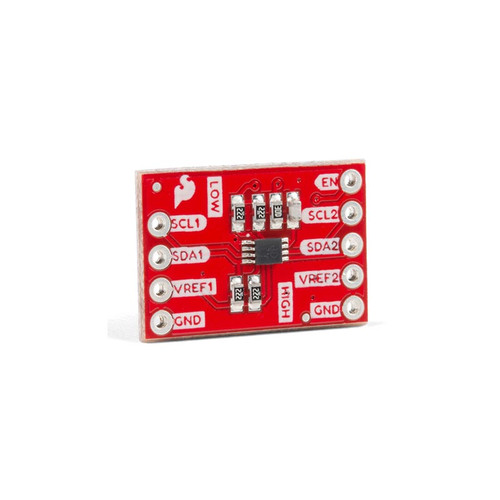
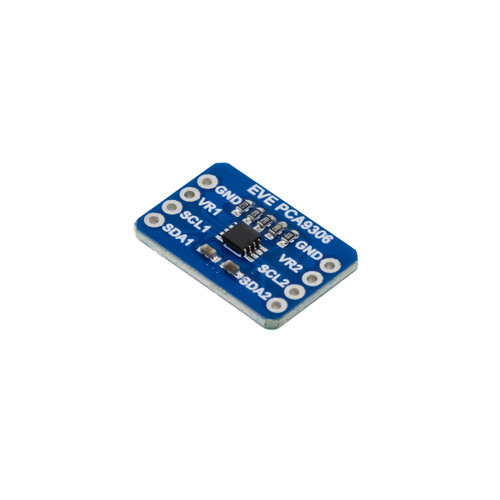
The Texas Instruments PCA9306DCTR is a dual bidirectional voltage-level translator designed for I2C, SMBus, and other open-drain digital interfaces operating across different voltage domains. It supports VREF1 voltages from 1.2–3.3 V and VREF2 voltages from 1.8–5.5 V, enabling level translation between common 1.2 V, 1.8 V, 2.5 V, 3.3 V, and 5 V systems. Because translation is bidirectional and does not require a direction-control pin, the device is well-suited for SDA and SCL lines where signal direction changes dynamically during communication.
The PCA9306 uses low-resistance pass switches with approximately 3.5 Ohm ON-state resistance, resulting in less than 1.5 ns maximum propagation delay and minimal signal distortion. When the EN pin is high, the SCL and SDA channels connect across the 2 voltage domains; when EN is low, the ports enter a high-impedance state for bus isolation. This functionality also allows a slower 100 kHz bus section to be disconnected while another section operates at up to 400 kHz, making the device useful in mixed-speed embedded systems.
Key Features
- Dual Bidirectional Translation: Provides 2 independent channels for voltage translation between mixed-voltage digital buses.
- I2C and SMBus Compatible: Designed specifically for bidirectional open-drain clock and data lines.
- 1.2–3.3 V VREF1 Range: Supports low-voltage processors, microcontrollers, sensors, and logic devices.
- 1.8–5.5 V VREF2 Range: Allows connection to higher-voltage I2C and SMBus peripherals.
- 1.2 V to 5 V Level Translation: Supports common voltage combinations including 1.2 V, 1.8 V, 2.5 V, 3.3 V, and 5 V.
- No Direction Pin Required: Automatically supports bidirectional data flow without separate direction-control logic.
- 400 kHz Bus Support: Suitable for standard-mode and fast-mode I2C communication.
- 100 kHz / 400 kHz Bus Isolation: EN control can disconnect a slower bus section during higher-speed communication.
- 3.5 Ohm ON Resistance: Low switch resistance minimises signal distortion between the 2 bus domains.
- <1.5 ns Propagation Delay: Low device delay supports fast I2C and SMBus communication.
- Open-Drain I/O Ports: SCL1, SDA1, SCL2, and SDA2 are designed for open-drain bus architectures.
- 5 V-Tolerant I/O: Supports mixed-voltage I2C operation with higher-voltage peripherals.
- Enable Control: The EN pin enables or disconnects the translation switches.
- High-Impedance Isolation: SCL and SDA ports are isolated when EN is low.
- Lockup-Free Disable Operation: Helps maintain bus isolation when the translator is disabled.
- Flow-Through Pinout: Simplifies PCB routing between low-voltage and high-voltage bus domains.
- 400 pF I2C Bus Capacitance Support: Suitable for standard I2C bus-capacitance limits when total loading is correctly managed.
- High Latch-Up Performance: Exceeds 100 mA according to JESD78 Class II testing.
- ESD Protection: Provides 2 kV HBM and 1 kV CDM protection.
- Industrial Temperature Range: Rated for operation from -40°C to +85°C.
- Compact SSOP-8 Package: 2.95 x 4 mm package supports space-constrained embedded designs.
- Tape-and-Reel Packaging: PCA9306DCTR is supplied in 3,000-piece reels for automated PCB assembly.
Applications
- I2C voltage-level translation
- SMBus interfaces
- PMBus interfaces
- MDIO interfaces
- Low-speed SDIO
- GPIO translation
- UART interfaces
- Sensor interfaces
- Mixed-voltage microcontroller systems
- Processor-to-peripheral communication
- Servers
- Network routers
- Telecom equipment
- Personal computers
- Industrial automation
- Embedded systems
- IoT devices