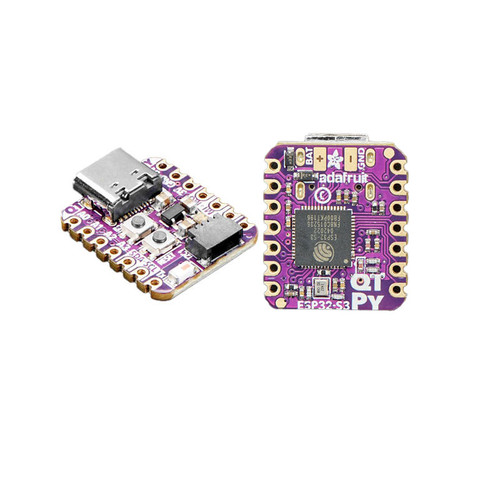
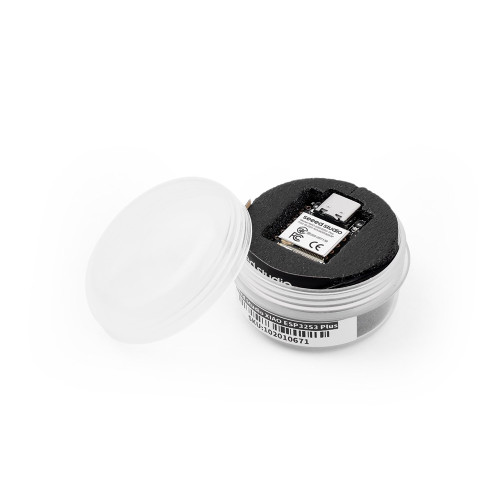
Seeed Studio XIAO ESP32-S3 Plus 240 MHz Dual-Core WiFi and BLE 5.0 Development Board with 16 MB Flash and 20 GPIOs
The Seeed Studio XIAO ESP32-S3 Plus is a compact development board built around the ESP32-S3 dual-core Xtensa 32-bit LX7 processor running at up to 240 MHz. It keeps the 21 x 17.8 mm XIAO form factor and adds redesigned castellations and a new back pad layout. These give 9 additional GPIOs through 1.27 mm pitch SMD pins, for a total of 20 GPIOs. The board also carries 16 MB of flash memory, so it has room for larger programs and data. WiFi, BLE 5.0 and a 2.4 GHz rod antenna are onboard for wireless projects.
The board works with Arduino, MicroPython and ESP-IDF. It draws 14 uA in deep sleep mode and has integrated Li-ion battery charging, which suits wearables and battery-powered devices. The extra SMD pins allow board-to-board soldering for projects that need more I/O than a standard XIAO. It is well-suited to IoT nodes, smart-home devices, robotics and wireless prototypes. Its standard backside layout, with aligned battery and debugger pads, also supports XIAO expansion boards and add-ons.
Key Features
- High-Performance MCU: Dual-core ESP32-S3 at up to 240 MHz, compatible with Arduino, MicroPython and ESP-IDF.
- Advanced Wireless: 2.4 GHz WiFi and BLE 5.0, with a 100 m+ range when used with a U.FL antenna.
- Expanded I/O: 20 GPIOs, including 9 additional 1.27 mm pitch SMD castellation pins.
- 16 MB Flash Memory: Upgraded storage for larger and more advanced applications.
- Efficient Power Management: 4 power modes with 14 uA deep sleep current and integrated Li-ion charging.
- Classic XIAO Form Factor: 21 x 17.8 mm size with 2.54 mm pin headers and single-sided mounting for wearables and space-limited projects.
- Universal Backside Layout: Aligned battery pads and debugger pads for XIAO expansion boards.
- Add-On Compatibility: Works with XIAO accessories such as LoRa, CAN-Bus and RS-485 modules, sensors, ePaper displays, LED matrix and relay boards.
Applications
- Internet of Things (IoT) nodes
- Wearable devices
- Smart-home devices
- Robotics
- Health monitoring
- Education and learning projects
- ESP-NOW communication
- Low-power (LP) networking
- Advanced Bluetooth projects needing extra I/O
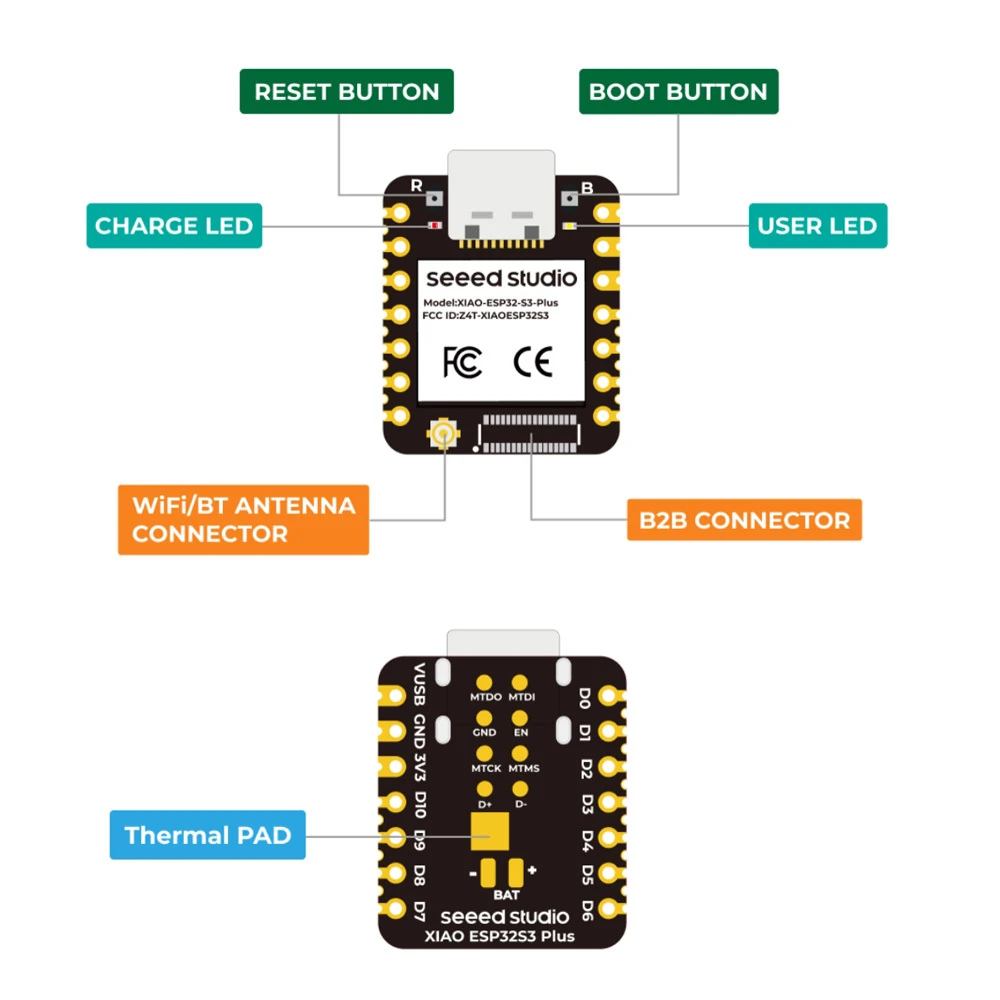
Hardware Overview

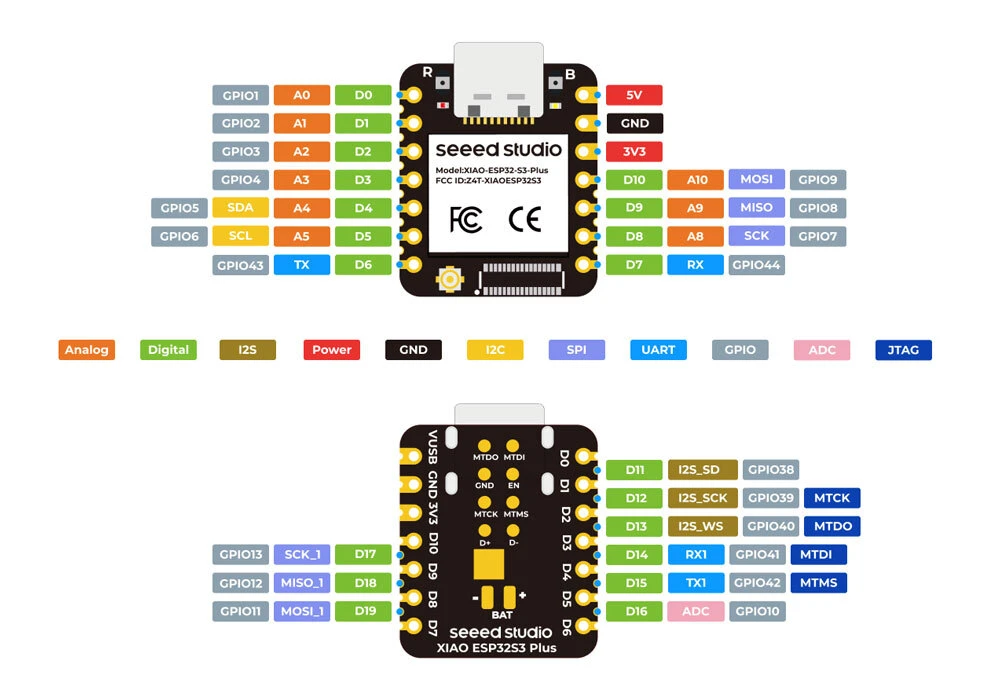
Pinouts