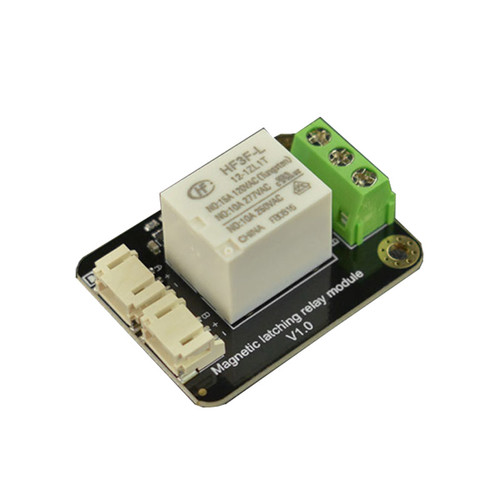
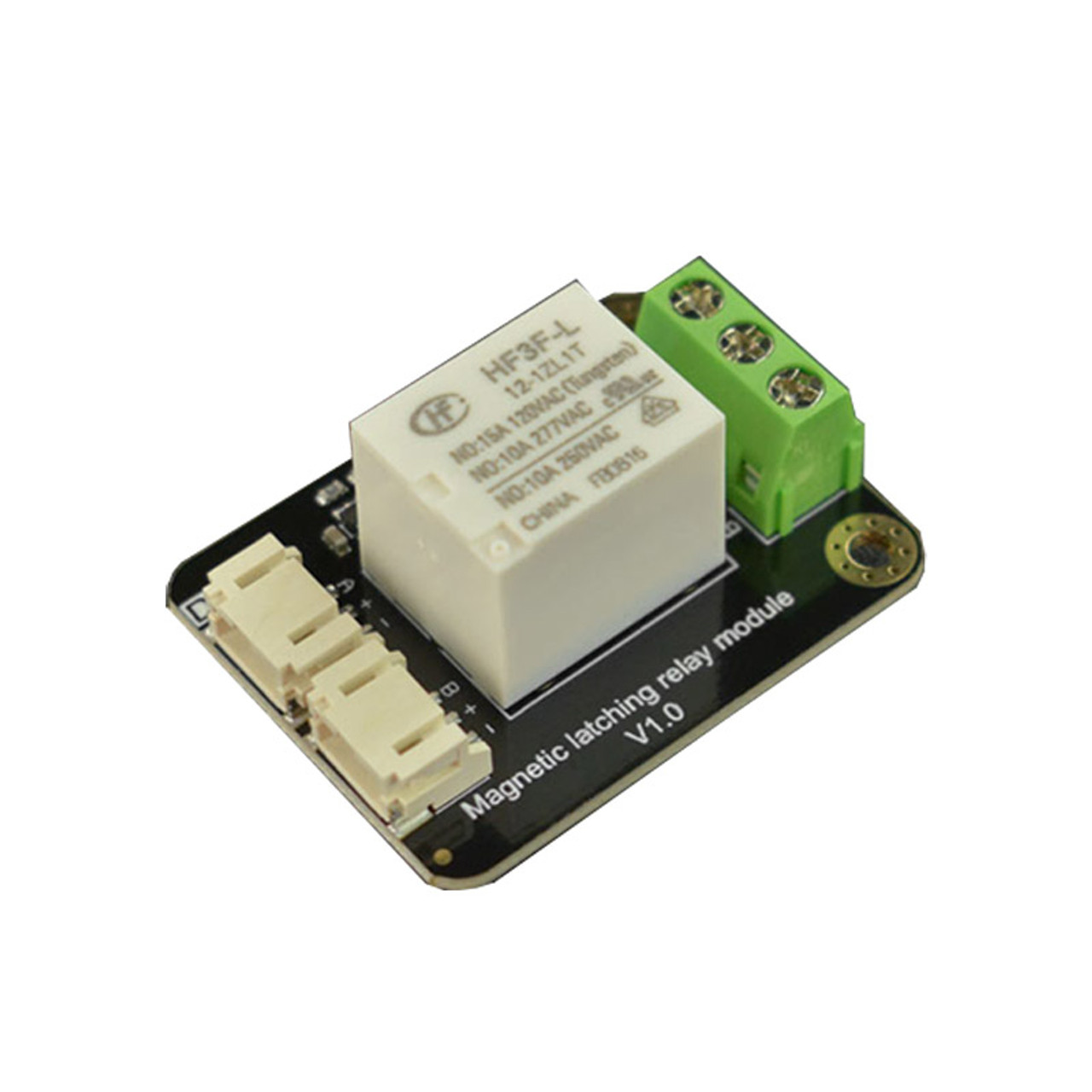
A magnetic latching relay is an innovative type of relay that offers several advantages. One notable feature is its low power dissipation, which helps conserve energy in the application circuit. Additionally, it operates silently, unlike non-latching relays that produce a humming sound during operation.
Unlike typical relays, the latching relay requires two digital pulse signals to switch between the ON and OFF states. Once switched, it remains in the last position even when not powered, serving as a memory circuit. This characteristic has led to it being referred to as bistable, keep impulse, or lockup relay.
The DFRobot Gravity: magnetic latching relay is designed to be compatible with popular microcontrollers such as ESP32, Arduino, and Raspberry Pi. This compatibility makes it suitable for various applications, including the remodeling of home appliances and lighting controls. Examples of such applications include smart electricity meters, lighting systems, sockets, switches, and more.
In terms of performance, the magnetic latching relay boasts low power consumption, steady operation, long service life, and minimal temperature rise. These attributes make it an ideal choice for applications that require both low power consumption and high stability.
When deciding between a latching or non-latching relay, it is crucial to consider the specific requirements of the application. Latching relays are suitable when power consumption and noise levels need to be kept low. On the other hand, non-latching relays may be more cost-effective for situations requiring a short time delay.
Ultimately, the choice between latching and non-latching relays depends on the designer's discretion and the implementation requirements of the system. Careful consideration should be given to select the appropriate relay type, as multiple options may be viable for a given application.
Key Features
- Magnetic Latching Relay: Maintains state without continuous power consumption
- Low Power Operation: Ideal for battery-powered and energy-efficient systems
- Gravity Interface: Plug-and-play compatibility with ESP32 and Arduino platforms
- Microcontroller Compatible: Easy integration into embedded and IoT projects
- Stable Switching Performance: Reliable relay operation for automation tasks
- Compact Design: Suitable for compact electronic systems
- Efficient Control: Consumes power only during switching events
- Wide Application Support: Suitable for smart home, industrial, and automation systems

Connection Diagram of Magnetic Latching Relay and Arduino
Applicaiton
- Remaking home appliances
- Lighting controls
- Smart electricity meters
- Smart lighting
- Smart sockets
- Smart switches
Package Contents
- Magnetic Latching Relay ×1
- 3Pin Gravity Wire ×2