Technical Specifications
Warranty Information
All the products supplied by Evelta are genuine and original. We offer 14 days replacement warranty in case of manufacturing defects. For more details, please visit our cancellation and returns page.
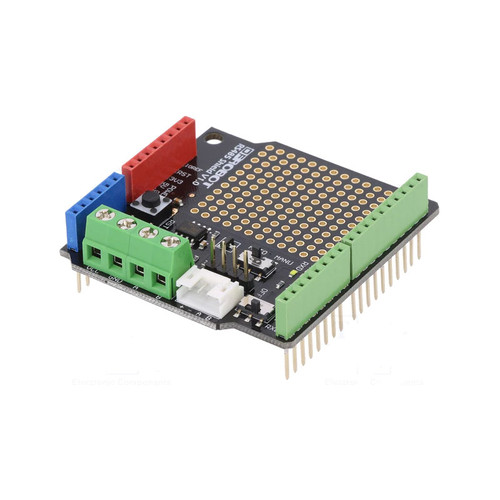
The DFRobot Beetle BLE is an ultra-compact Arduino Uno-compatible development board integrating Bluetooth 4.0 Low Energy directly onto one of the smallest BLE-enabled microcontroller boards available in the Arduino ecosystem. Built around the ATmega328 running at 16MHz, the Beetle BLE delivers the same processing core as a full-size Arduino Uno in a footprint sized for space-constrained wearable, embedded, and IoT projects where board dimensions directly limit design feasibility. Code is uploaded and developed entirely within the standard Arduino IDE without additional libraries, drivers, or board manager packages beyond what the standard IDE installation provides, keeping the development workflow familiar for anyone with existing Arduino experience and removing the setup friction common with third-party BLE development boards.
The Beetle BLE is fully compatible with the DFRobot Bluno series in terms of firmware, instructions, and wireless programming procedures, allowing builders already working within the Bluno ecosystem to integrate the Beetle BLE into existing projects without adapting code or communication protocols. Bluetooth HID mode enables the board to present itself directly to a host device as a standard Bluetooth keyboard, mouse, or gamepad without requiring custom application software on the connected device, making it directly applicable to wireless human-interface projects and accessibility builds. iBeacon mode supports Bluetooth proximity broadcasting for indoor positioning, retail, and location-aware IoT applications. Wireless programming over BLE eliminates the need to physically access the board for firmware updates in sealed or hard-to-reach enclosures, a significant practical advantage in wearable and permanently installed embedded deployments. The micro USB port handles both wired programming and power supply, maintaining compatibility with standard USB development cables and power banks.
Key Features