Resources:
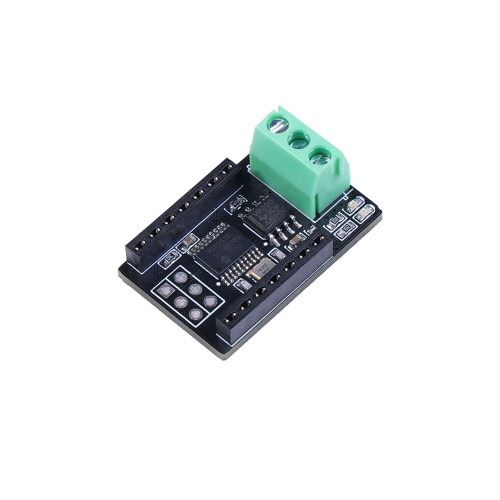
Seeed Studio CAN Bus Breakout Board for XIAO with MCP2515, SN65HVD230 and 1 Mbps CAN Communication
The Seeed Studio CAN Bus Breakout Board is a compact expansion module designed to add CAN Bus communication to compatible XIAO development boards. It integrates the Microchip MCP2515 stand-alone CAN controller and Texas Instruments SN65HVD230 CAN transceiver, providing the protocol-control and physical-layer functions required for CAN networking. The MCP2515 communicates with the host microcontroller through SPI and supports CAN 2.0B communication at data rates up to 1 Mbps.
For convenient field wiring, CAN-H, CAN-L, and GND are accessible through the onboard terminal connection, while RX and TX LEDs provide visual communication status. The board also includes a configurable 120 Ohm CAN termination resistor that can be enabled by shorting the P1 solder pad when required by the network topology. Its compact XIAO-compatible form factor makes it suitable for automotive diagnostics, robotics, industrial control, distributed sensors, and IoT gateway applications.
Key Features
- MCP2515 CAN Controller: Integrated stand-alone CAN controller manages message transmission, reception, filtering, and CAN protocol functions.
- SN65HVD230 Transceiver: Converts logic-level CAN controller signals into the differential CAN-H and CAN-L signals used on the physical bus.
- CAN 2.0B Support: Supports standard and extended CAN data frames for a wide range of embedded networking applications.
- Up to 1 Mbps CAN Speed: Supports CAN Bus communication rates up to 1 Mbps for high-speed device networking.
- SPI Host Interface: MCP2515 communicates with the connected XIAO microcontroller using the SPI interface.
- XIAO Expansion Design: Provides a convenient hardware platform for adding CAN communication to compatible Seeed Studio XIAO boards.
- CAN-H and CAN-L Terminal Connection: Onboard terminal simplifies connection to an external CAN network.
- Ground Terminal: Provides a convenient common ground connection alongside the CAN differential pair.
- Optional 120 Ohm Termination: P1 solder pad allows the onboard CAN termination resistor to be enabled when the module is positioned at a bus endpoint.
- RX/TX LED Indicators: Visual indicators help monitor CAN receive and transmit activity during development and troubleshooting.
- Message Filtering: MCP2515 includes 2 acceptance masks and 6 acceptance filters to reduce unnecessary host-MCU processing.
- Standard and Extended Frames: Supports both 11-bit standard identifiers and 29-bit extended CAN identifiers.
- Arduino Library Support: Seeed provides an MCP2515 CAN library with transmission, reception, filtering, and OBD-II examples.
- Compact Form Factor: Suitable for space-constrained embedded systems, vehicle interfaces, robots, and portable diagnostic devices.
- Modular XIAO Ecosystem: Can be combined with different XIAO boards to add wireless, sensing, processing, or gateway functions to CAN applications.
Applications
- Automotive diagnostics
- OBD-II projects
- Vehicle data logging
- Automotive sensor networks
- Industrial control systems
- Robotics communication
- Distributed motor controllers
- CAN sensor networks
- Industrial data acquisition
- IoT gateways
- Vehicle telemetry
- Battery-management prototypes
- Embedded control systems
- CAN monitoring tools
- Educational CAN Bus projects
- XIAO-based CAN nodes
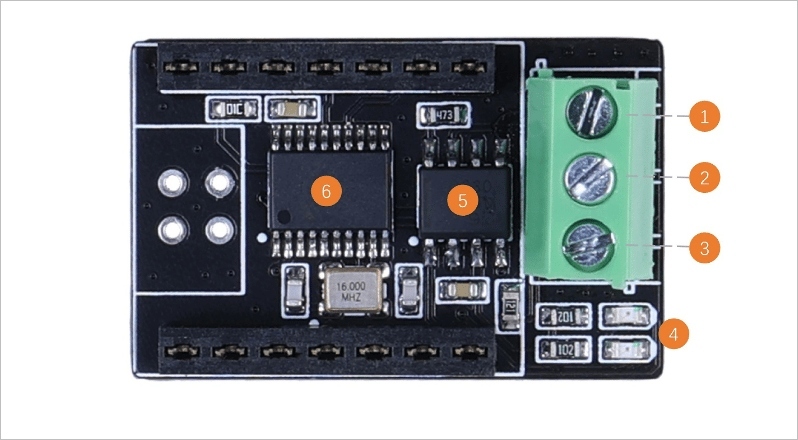
Hardware Overview
- GND
- CANH
- CANAL
- LED Indicators for RX/TX
- SN65NVD230
- MCP2515
Package Includes:
- Seeed Studio CAN-Bus Breakout Boardx1