Adafruit LTC4316 I2C Address Translator Breakout with STEMMA QT and Qwiic Connectors - On-the-Fly I2C Address Translation with DIP Switch Configuration for Fixed-Address Sensor Conflicts
The Adafruit LTC4316 I2C Address Translator is a hardware solution to one of the most common practical limitations in I2C peripheral integration - the address conflict that arises when a project requires multiple instances of the same sensor or module on a single I2C bus, where the peripheral has a fixed or minimally adjustable I2C address with no available alternative. Built around the Linear Technology LTC4316 IC, this breakout performs real-time, on-the-fly I2C address translation between an input I2C bus half and an output I2C bus half, automatically remapping the 7-bit addresses of all devices connected to the output side before presenting them to the I2C controller on the input side, without requiring any firmware modification, software address remapping, or changes to the peripheral device itself. The peripheral on the output side continues to operate normally on its native address while the I2C controller on the input side communicates with it on the translated address, making the translation process entirely transparent to both the controller and the peripheral.
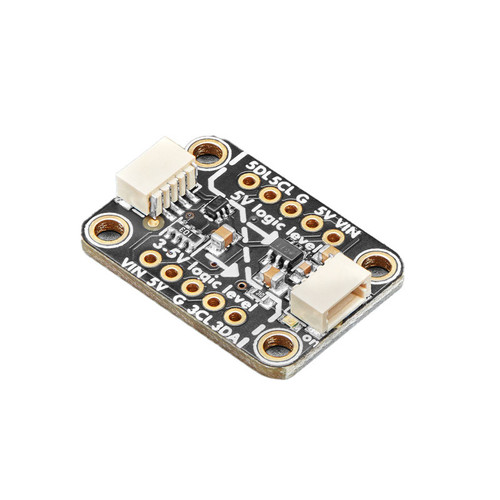
Address translation is performed using XOR bitwise arithmetic applied to the upper bits of the 7-bit I2C address. Bit A6, the most-significant address bit, is always flipped by the LTC4316. Bits A5 and A4 are independently controlled by 2 onboard DIP switches, allowing the builder to select from 4 distinct address translation offsets by toggling the switches without reflashing firmware or modifying hardware. As a worked example, an AHT20 sensor with a fixed address of 0x38 connected to the output side will appear at 0x78 when both DIP switches are ON (0x38 XOR 0x40), at 0x58 when the A5 switch is OFF (0x38 XOR 0x60), and at 0x48 when both switches are OFF (0x38 XOR 0x70), with the AHT20 itself remaining unaware of the translation at all times. STEMMA QT and Qwiic connectors on both the input and output sides of the breakout allow direct daisy-chain integration into STEMMA QT and Qwiic sensor ecosystems without soldering, while standard 0.1-inch header pads retain compatibility with breadboard and perfboard builds.
Key Features
- Translator IC: Linear Technology LTC4316 real-time I2C address translation between input and output bus halves without firmware modification
- On-the-Fly Address Translation: Automatic XOR-based address remapping applied to all devices on the output I2C bus, transparent to both I2C controller and peripheral
- Fixed A6 Bit Flip: Bit A6 (most-significant address bit) is always flipped by the LTC4316, providing a baseline address offset on all connected output-side devices
- DIP Switch Configurable: 2 onboard DIP switches independently control A5 and A4 bit flipping, providing 4 selectable address translation offsets without firmware changes
- XOR Address Translation: Translation offset determined by XOR bitwise arithmetic - translated address equals native address XOR offset (0x40, 0x60, or 0x70 depending on DIP switch state)
- Peripheral-Transparent Operation: Output-side devices operate normally on their native addresses and are unaware of the address translation applied on the input side
- STEMMA QT and Qwiic Connectors: Input and output STEMMA QT / Qwiic JST-SH connectors for solder-free integration into STEMMA QT and Qwiic sensor ecosystems
- Breadboard Compatible: Standard 0.1-inch header pads retain full breadboard and perfboard build compatibility alongside STEMMA QT / Qwiic connectors
- Resolves Fixed-Address Conflicts: Enables multiple instances of fixed-address peripherals (sensors, displays, ADCs) on a single I2C bus without hardware modification
- No Firmware Modification Required: Address translation is handled entirely in hardware by the LTC4316, requiring no software address remapping or driver changes.
Applications
- Multiple instances of fixed-address I2C sensors (AHT20, SHT31, BMP280, and similar) on a single I2C bus without address conflict
- STEMMA QT and Qwiic sensor chain builds requiring duplicate sensor types at distinct I2C addresses
- Arduino, Raspberry Pi, and CircuitPython projects requiring hardware I2C address remapping without firmware address translation overhead
- Embedded I2C bus designs with address-constrained peripherals where software address management is impractical or unavailable
- Prototyping and sensor evaluation builds require rapid address conflict resolution via DIP switch without reflashing
- Multi-sensor data logging and environmental monitoring builds using identical sensor modules at independent I2C addresses on a shared bus