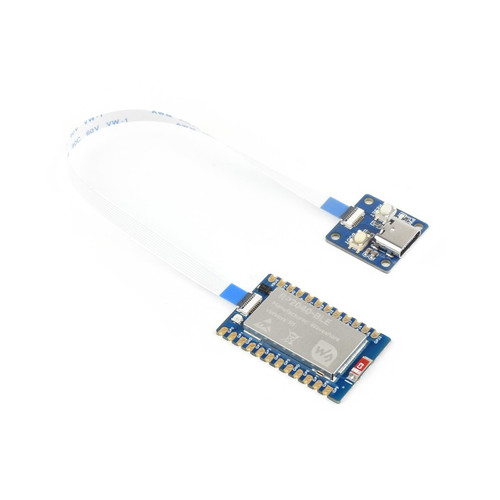
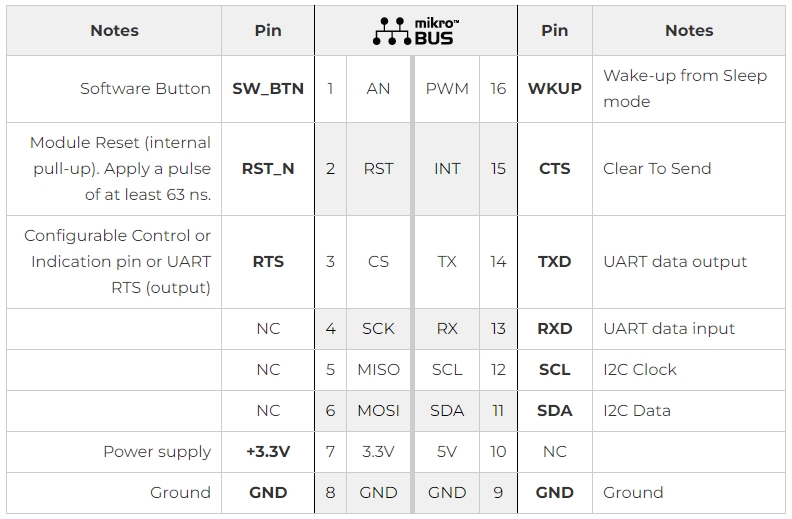
The MIKROE-2545 RN4678 Click Board integrates the RN4678 Bluetooth 4.2 dual mode module from Microchip. It is designed to run on a 3.3V power supply. It communicates with the target microcontroller over I2C and UART interface, with additional functionality provided by the following pins on the mikroBUS line: AN, RST, CS, PWM, INT.
Key Features
Frequency: 2.402 GHz to 2.480 GHz, RX Sensitivity: -90 dBm (BR/EDR), -92 dBm (LE), Bluetooth SIG 4.2 Qualified
RN4678 Features
- The RN4678 from Microchip is a fully certified, Bluetooth version 4.2 module. Use it to add Bluetooth wireless capability to your project.
- The module includes an on-board Bluetooth stack, power management subsystem, 2.4 GHz transceiver, and RF power amplifier.
- Data transfer is achieved through the Bluetooth link by sending or receiving data through SPP in Bluetooth (BT) Classic mode and through Transparent UART in the BLE mode.
- The RN4678 contains an integral ceramic chip antenna.
- The RN4678 module has strong AES128 Encryption. A 128-bit encryption is one of the most powerfull encryption algorithms. AES stands for Advanced Encryption Standard and it is a symmetric encryption algorithm.
RN4678 Click Board Pinouts
Jumper and Settings
| Designator |
Name |
Default Position |
Default Option |
Description |
| JP1 |
P2_0 |
Left |
HIGH |
System configuration pin - Along with P2_4 and EAN pins, used to set the module in any of the following three modes: Application mode (for normal operation), Test mode (to change EEPROM values), and Write Flash mode (to enter the new firmware into the module) |
| JP2 |
P2_4 |
Left |
HIGH |
System configuration pin - Along with P2_0 and EAN pins, used to set the module in any of the following three modes: Application mode (for normal operation), Test mode (to change EEPROM values), and Write Flash mode (to enter new firmware into the module) |
| JP3 |
EAN |
Right |
LOW |
External address-bus negative pin. System configuration pin along with P2_0 and P2_4 pins, used to set the module in any of the following three modes: Application mode (for normal operation), Test mode (to change EEPROM values), and Write Flash mode (to enter new firmware into the module); |
Resources