Resources:
Wiki: www.waveshare.com/wiki/ESP32-S3-DualEye-Touch-LCD-1.28
ESP32-S3 1.28inch Double Eye Round LCD AIoT Development Board, Onboard Dual 1.28inch IPS Displays, 240x240 Resolution, Dual-core 240MHz Processor, Supports Wi-Fi / Bluetooth 5
The ESP32-S3-DualEye-Touch-LCD-1.28 is an innovative AIoT microcontroller development board built on the ESP32-S3 platform, featuring dual 1.28-inch round LCD displays for creative visual applications. Designed for makers, developers, and electronics enthusiasts, this compact yet powerful board supports 2.4GHz Wi-Fi and Bluetooth 5 (LE) connectivity, making it perfect for intelligent robotics, HMI interfaces, and voice-interactive AI projects.
Powered by the Xtensa 32-bit Lx7 dual-core processor running at up to 240MHz, the board provides high-speed performance and efficiency. It integrates 512KB SRAM, 384KB ROM, 8MB PSRAM, and 16MB Flash memory, enabling smooth execution of advanced GUI applications such as LVGL, animations, and AI-driven tasks. The dual 1.28-inch LCD displays with 240x240 resolution and 65K colours offer vibrant visuals and the flexibility to design unique “double-eye” interfaces for robots, smart wearables, and IoT devices.
Key Features
- High-Performance MCU: Powered by the Xtensa 32-bit Lx7 dual-core processor up to 240MHz.
- Ample Memory: Built-in 512KB SRAM, 384KB ROM, with onboard 8MB PSRAM and 16MB Flash for complex applications.
- Wireless Connectivity: Supports 2.4GHz Wi-Fi (802.11 b/g/n) and Bluetooth 5 (LE) for wireless communication and IoT integration.
- Dual Round LCD Displays: Two 1.28-inch IPS screens (240x240 resolution, 65K colours), optional touch support for rich user interfaces.
- Audio System: Integrated ES8311 audio codec and ES7210 audio ADC, with built-in microphone and speaker header for AI voice interaction.
- TF Card Slot: Supports local storage expansion for data logging, image, and audio file storage.
- Battery Management: Onboard 3.7V lithium battery charging circuit with rechargeable power header.
- Expansion Interface: SH1.0 14-pin connector supporting UART, I2C, and IO for flexible module integration.
- Supports GUI Frameworks: Compatible with LVGL and other graphical user interface libraries for creative HMI development.
- Ideal Applications: HMI displays, AI voice devices, “double-eye” robots, smart toys, IoT terminals, and futuristic wearables.
Capacitive Touch
Optional for capacitive touch function, controlled via I2C interface for flexible operation
and smooth UI interaction, with interrupt support
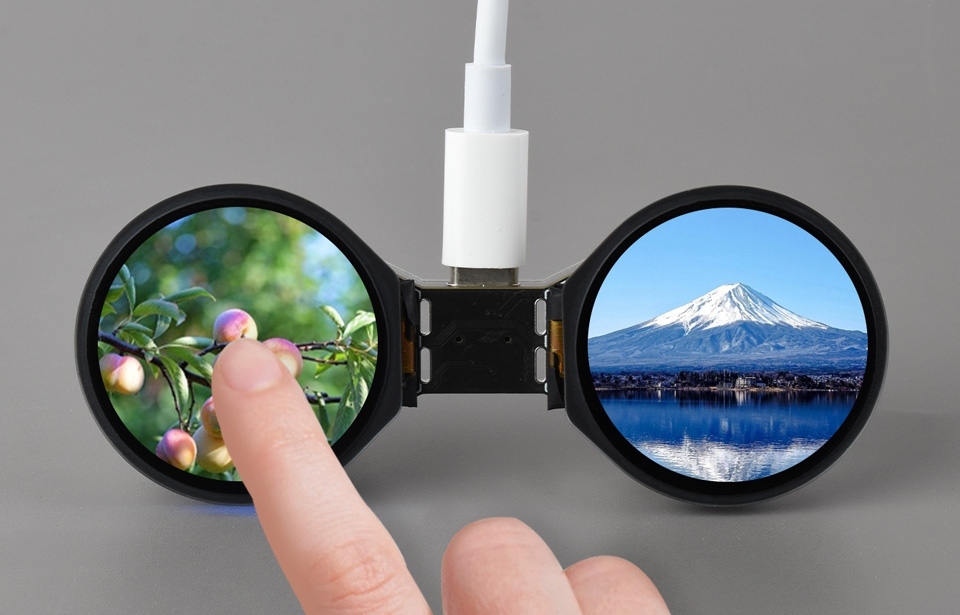
Only the ESP32-S3-DualEye-Touch-LCD-1.28 version supports touch function.
What's On Board
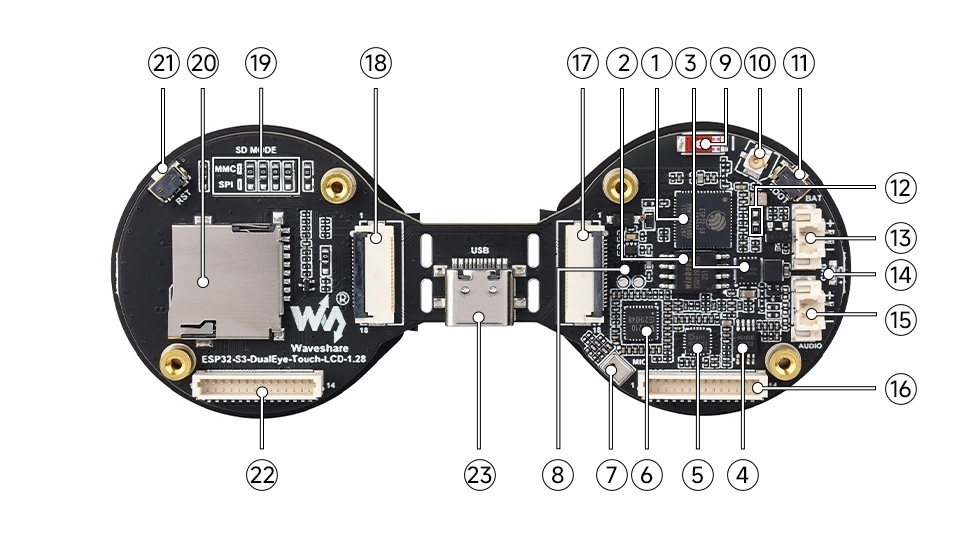
- ESP32-S3R8
Dual-core processor, up to 240MHz operating frequency
- 16MB Flash
- Battery recharge management chip
- Amplifier chip
- ES8311
- ES7210
- Microphone
- MP1605GTF-Z
Power module, supports up to 3.3V 2A output
- Onboard ceramic antenna
- IPEX1 connector
for connecting external antenna, enabled via resoldering an onboard resistor
- BOOT button
- GPIO1 function selection resistor
soldered on the side near the crystal by default: the GPIO1 pin is used for battery voltage measurement.
resoldered to the other side: the GPIO1 connects to the 17. FPC connector, enabling three-screen display function through software modification
- Battery header
MX1.25 2PIN connector, for 3.7V Lithium battery, supports charging and discharging
- Charge indicator
Lithium battery charge indicator, lights up when charging, off when fully charged (the light status is uncertain when the battery is not connected)
- Speaker header
- SH1.0 14PIN header
- 18PIN FPC connector
for three-screen display function by resoldering the 12. resistor and modifying the display configuration parameters in the program.
when the board is split into two halves, this FPC connector can be linked with 18. FPC connector so that both displays function properly (Note: when the board is split and connected via FPC cable, the RESET button will be unavailable)
- 18PIN FPC header
for connection to the host
- TF card communication mode selection
when the board is split into two halves, switching to SPI mode allows the TF card to be controlled by an external master controller.
- TF card slot
Supports high-capacity TF cards
- RESET button
- SH1.0 14PIN cable header
for controlling TF card and the LCD display via SPI interface when the board is split into two halves and resoldering 19. resistor to SPI mode
- Type-C port
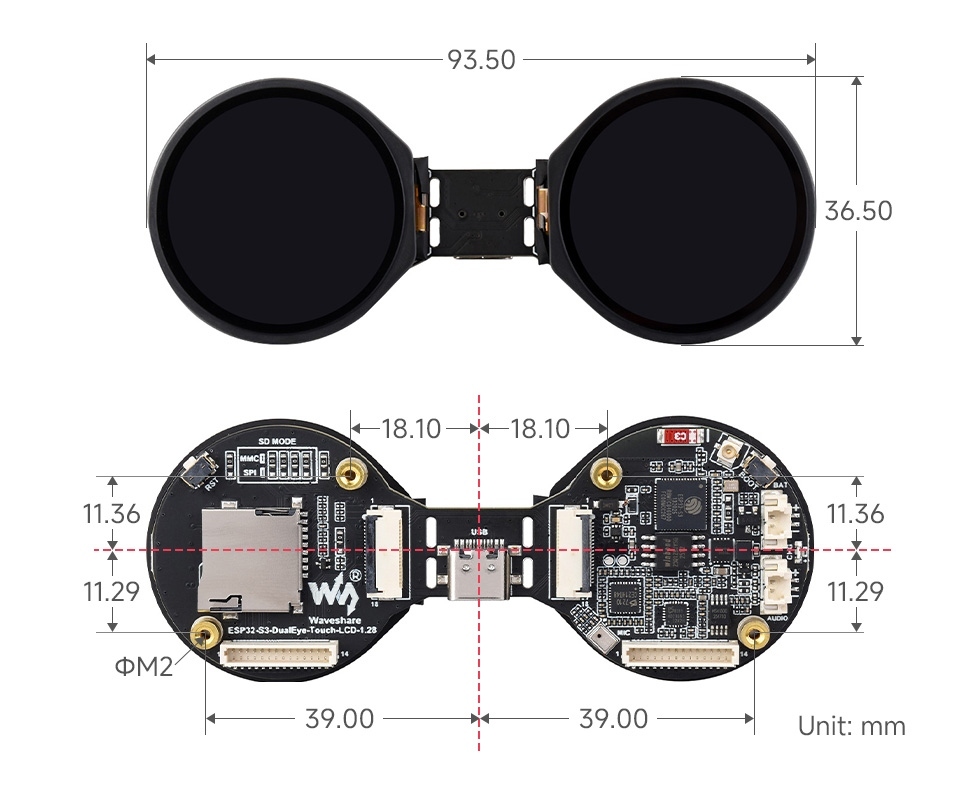
Dimensions
Package Content:
- ESP32-S3-DualEye-LCD-1.28x1
- ESP32-S3-DualEye-Touch-LCD-1.28x1
- SH1.0 14PIN cable ~100mmx1
- FFC 18PIN cable ~200mmx1
- 8Ω 2W MX1.25 2PIN speakerx1